Cerebrolysin (215 mg/mL, 10 mL)
Cerebrolysin is a porcine-derived peptide preparation rich in neurotrophic factors and amino acids. Its neuroprotective and neurotrophic actions stem from constituents such as BDNF, NGF, CNTF, GDNF, P-21, enkephalins, and orexin, making it a versatile tool for neurological research.
PEPTIDES LIST
- Adipotide (FTPP)
- AICAR
- AOD9604
- ARA-290
- B7-33
- BPC-157
- Bronchogen
- Cagrisema
- Cagrilintides
- Cardiogen
- Cartalax
- Cerebrolysin (215mg/ml, 10ml)
- Chonluten
- CJC-1295 DAC
- Cortagen
- DSIP
- Epithalon (Epitalon)
- Follistatin-315
- Follistatin-344
- FOXO4-DRI
- GHK-Cu (Copper Peptide)
- GHK Basic
- GHRP-2
- GHRP-6
- GHRH (GH-Releasing Hormone)
- Glutathione
- Gonadorelin (GnRH)
- GLP2 & GLP3
- hGH Fragment 176-191
- Hexarelin
- Humanin
- Ipamorelin
- Kisspeptin-10
- KPV (ACTH (11-13) alpha-MSH)
- Liraglutide (GLP-1 Analogue)
- Livagen
- LL-37 (CAP-18)
- Melanotan 2 (Melanotan II)
- Mezdutide
- MGF (C-terminal)
- ModGRF 1-29 (CJC-1295 No DAC)
- MK-677 (Ibutamoren)
- MOTS-c
- N-Acetyl Epithalon Amidate
- N-Acetyl Selank Amidate
- N-Acetyl Semax Amidate
- NAD+
- Ovagen
- Oxytocin+
- Pancragen
- PE-22-28
- PEG-MGF (Pegylated MGF)
- Pinealon
- PNC-27
- Prostamax
- PT-141 (Bremelanotide)
- P21 (P021)
- Retatrutide
- Snap8
- Tesa_Ipa_Blend
- Triblend
- Selank
- Semaglutide (GLP-1 Analogue)
- Semax
- Sermorelin
- SS-31
- Survodutide
- TB-500
- Tesamorelin
- Testagen
- Thymagen
- Thyrotropin-TRH
- Tirzepatide
- Triptorelin
- Vesugenas
- Vesilute
- Vilon
- VIP (Vasoactive Intestinal Peptide)
- GLP2
- GLP3
- Klow
- Klow8
- SLU-PP-332
- BAM-15
- Orforglipron
- Noopept
- 9-Me-BC
- Methylene Blue
- Lemon Bottle

Cerebrolysin’s pharmacodynamic profile mirrors endogenous neurotrophic factors. It supports neuronal survival, fosters synaptic plasticity, and provides neuroprotection—traits that underpin its use across neurodegenerative and neurotraumatic research.
Cerebrolysin is described as a peptide/amino-acid mixture derived from porcine brain proteins, formulated to cross the blood–brain barrier and support neuronal health. The article frames it as having neuroprotective and neurotrophic actions—supporting synaptic connectivity and repair-focused signaling. Educational context only.
Route & Frequency (as described):
Cerebrolysin is described as administered by intramuscular (IM) or intravenous (IV) injection (not oral). Protocols vary by condition severity, commonly using daily dosing or 5×/week schedules.
| Use Case / Condition | Dose (mL) | Frequency | Duration / Cycling Notes |
|---|---|---|---|
| Stroke (Acute Phase) | 20–50 mL | Daily | 21 days; described as higher-dose early rehab support |
| Vascular Dementia | 10–30 mL | 5×/week | 4 weeks; repeat 2–4 cycles/year |
| Alzheimer’s Disease | 10–30 mL | 5×/week | 4 weeks; repeat 2–4 cycles/year |
| Traumatic Brain Injury (TBI) | 20–50 mL | Daily | 7–30 days; varies by severity; start early post-injury if possible |
| Nootropic / Off-label Cognitive Use | 1–5 mL | 5×/week | 4 weeks; described as lower-dose cognitive / mood / neuroprotection cycle |
| “Standard Cognitive Support” (general) | 5 mL | Daily (IM) | Often described as a ~4-week cycle unless otherwise directed |
Caution (as noted in the article):
• Dose selection is described as condition- and severity-dependent; the article notes analyses reporting modest benefits in some settings and the possibility of serious non-fatal adverse effects.
• Special note included: avoid “very high doses” (example given >80 mL) at initiation to reduce the chance of negative reactions.
• The article also recommends use under medical supervision due to potential medication interactions.
Reconstitution / Handling:
The article presents Cerebrolysin as an injectable solution (IM/IV) and does not describe vial reconstitution with bacteriostatic water. Typical handling in this context:
• Use aseptic technique; inspect solution for clarity and packaging integrity.
• Use immediately after opening an ampoule/vial when applicable; do not “save” opened containers unless the manufacturer explicitly allows it.
• Store and protect from light per the product label/spec sheet.
CAS Number: 12656-61-0
PubChem CID: 472407974
Synonyms: Cerebrolyzin, FPE-1070, Renacenz, 37KZM6S21G
As a naturally occurring peptide mixture, Cerebrolysin lacks a single molecular structure. The FDA granted it orphan designation for frontotemporal dementia and ALS, reflecting its therapeutic promise in rare neurological diseases.
Principal Components
- Brain-Derived Neurotrophic Factor (BDNF)
- Glial Cell Line-Derived Neurotrophic Factor (GDNF)
- Ciliary Neurotrophic Factor (CNTF)
- Nerve Growth Factor (NGF)
- Brain-Derived Neurotrophic Factor (BDNF)
- Glial Cell Line-Derived Neurotrophic Factor (GDNF)
- Ciliary Neurotrophic Factor (CNTF)
- Nerve Growth Factor (NGF)
BDNF: Supports neuron and synapse growth, influences stress response, and is implicated in psychiatric and neurodegenerative research.
GDNF: Sustains dopaminergic and motor neurons, offering avenues for Parkinson’s disease and ALS exploration.
CNTF: Facilitates neurotransmission and astrocyte development; investigated for ALS, appetite regulation, and retinal degeneration.
NGF: Regulates sensory and sympathetic neuron survival, immune modulation, and pancreatic beta-cell protection.
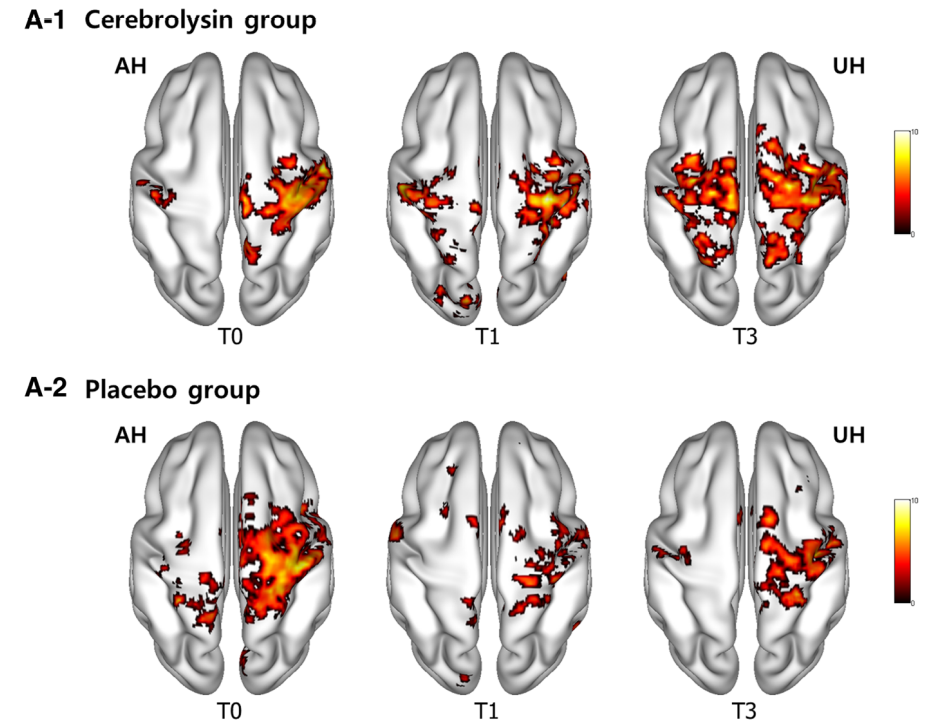
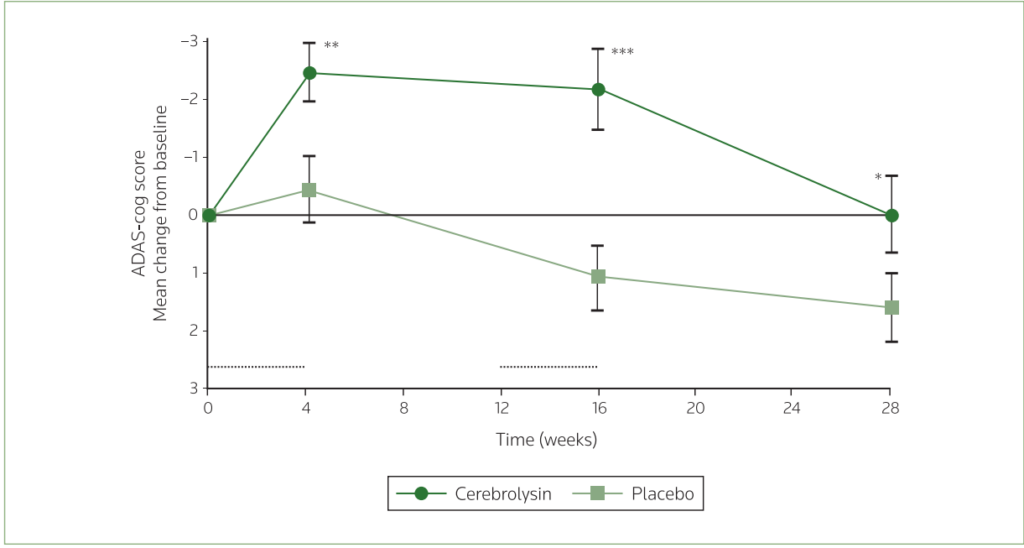
Dementia & Alzheimer’s: Trials report cognitive improvements lasting months after treatment, reductions in neuropsychiatric symptoms, and correlations between symptom relief and lowered amyloid-beta production.
Parkinson’s Disease: GDNF content protects dopaminergic neurons, with controlled-release delivery showing broad motor and biochemical benefits in animal studies.
Stroke & Brain Injury: Administration within 72 hours post-stroke enhances recovery, particularly when combined with rehabilitation. Severe stroke cases exhibit the greatest functional gains.
Traumatic Injury & Cerebral Palsy: Pediatric and adult studies highlight improvements in cognition and motor control when Cerebrolysin accompanies structured therapy programs.
Rodent models of chronic migraine and neuropathic pain show decreases in pro-inflammatory cytokines (TNF-α, IL-1β) and mitigation of pain behaviors after Cerebrolysin administration, hinting at novel therapeutic directions.
Cerebrolysin’s peptide constituents support neuron survival, neuroplasticity, and neurotransmitter modulation. Evidence spans ALS, Alzheimer’s, Parkinson’s, stroke, traumatic brain injury, and chronic pain. Ongoing research explores long-term neuroprotection and potential cognitive enhancement applications.
Article Author :
The above literature was researched, edited and organized by Dr. Logan, M.D. Dr. Logan holds a doctorate degree from https://case.edu/medicine/Case Western Reserve University School of Medicine and a B.S. in molecular biology.
Case Western Reserve University School of Medicine
ALL ARTICLES AND PRODUCT INFORMATION PROVIDED ON THIS WEBSITE ARE FOR INFORMATIONAL AND EDUCATIONAL PURPOSES ONLY.
The product information featured on this website pertains exclusively to in-vitro studies. In-vitro studies, also known as ‘in glass’ studies, are conducted outside of living organisms. It’s important to emphasize that these products do not constitute medicines or drugs and have not received FDA approval for the prevention, treatment, or cure of any medical conditions, ailments, or diseases. It is crucial to note that the introduction of these products into the bodies of humans or animals is strictly prohibited by law.
THIS PRODUCT IS INTENDED AS A RESEARCH CHEMICAL ONLY. This designation allows the use of research chemicals strictly for in vitro testing and laboratory experimentation only. All product information available on this website is for educational purposes only. Bodily introduction of any kind into humans or animals is strictly forbidden by law. This product should only be handled by licensed, qualified professionals. This product is not a drug, food, or cosmetic and may not be misbranded, misused or mislabled as a drug, food or cosmetic.