Peptides for Muscle Growth and Workout Recovery
Peptides have emerged as significant contributors to muscle growth and recovery. They enhance muscle protein synthesis, which is essential for athletes and fitness enthusiasts. Various peptides, including growth hormone secretagogues, play distinct roles in this process. Additionally, certain peptides aid in injury recovery and inflammation reduction. Understanding how these compounds function can provide insights into optimizing performance and recovery. What specific peptides should one consider for effective results?
PEPTIDES LIST
- Adipotide (FTPP)
- AICAR
- AOD9604
- ARA-290
- B7-33
- BPC-157
- Bronchogen
- Cagrisema
- Cagrilintides
- Cardiogen
- Cartalax
- Cerebrolysin (215mg/ml, 10ml)
- Chonluten
- CJC-1295 DAC
- Cortagen
- DSIP
- Epithalon (Epitalon)
- Follistatin-315
- Follistatin-344
- FOXO4-DRI
- GHK-Cu (Copper Peptide)
- GHK Basic
- GHRP-2
- GHRP-6
- GHRH (GH-Releasing Hormone)
- Glutathione
- Gonadorelin (GnRH)
- GLP2 & GLP3
- hGH Fragment 176-191
- Hexarelin
- Humanin
- Ipamorelin
- Kisspeptin-10
- KPV (ACTH (11-13) alpha-MSH)
- Liraglutide (GLP-1 Analogue)
- Livagen
- LL-37 (CAP-18)
- Melanotan 2 (Melanotan II)
- Mezdutide
- MGF (C-terminal)
- ModGRF 1-29 (CJC-1295 No DAC)
- MK-677 (Ibutamoren)
- MOTS-c
- N-Acetyl Epithalon Amidate
- N-Acetyl Selank Amidate
- N-Acetyl Semax Amidate
- NAD+
- Ovagen
- Oxytocin+
- Pancragen
- PE-22-28
- PEG-MGF (Pegylated MGF)
- Pinealon
- PNC-27
- Prostamax
- PT-141 (Bremelanotide)
- P21 (P021)
- Retatrutide
- Snap8
- Tesa_Ipa_Blend
- Triblend
- Selank
- Semaglutide (GLP-1 Analogue)
- Semax
- Sermorelin
- SS-31
- Survodutide
- TB-500
- Tesamorelin
- Testagen
- Thymagen
- Thyrotropin-TRH
- Tirzepatide
- Triptorelin
- Vesugenas
- Vesilute
- Vilon
- VIP (Vasoactive Intestinal Peptide)
- GLP2
- GLP3
- Klow
- Klow8
- SLU-PP-332
- BAM-15
- Orforglipron
- Noopept
- 9-Me-BC
- Methylene Blue
- Lemon Bottle

Peptides have emerged as significant contributors to muscle growth and recovery. They enhance muscle protein synthesis, which is essential for athletes and fitness enthusiasts. Various peptides, including growth hormone secretagogues, play distinct roles in this process. Additionally, certain peptides aid in injury recovery and inflammation reduction. Understanding how these compounds function can provide insights into optimizing performance and recovery. What specific peptides should one consider for effective results?
When considering the mechanisms behind muscle growth, peptides play an essential role in enhancing muscle protein synthesis. These short chains of amino acids serve as signaling molecules that can stimulate various biological processes related to muscle development. Specific peptides, such as CJC-1295 and MK-677, promote the release of growth hormone, which is vital for muscle repair and growth. By increasing the availability of amino acids and enhancing insulin-like growth factor (IGF-1) levels, peptides facilitate a more efficient protein synthesis process.
Additionally, peptides can help reduce muscle breakdown, thereby allowing for a net positive protein balance. This dual action not only supports muscle hypertrophy but also aids in recovery post-exercise. Athletes and bodybuilders may incorporate these peptides into their regimens to optimize training outcomes and expedite recovery times. Understanding how these compounds function can empower individuals to make informed decisions regarding their muscle-building strategies.
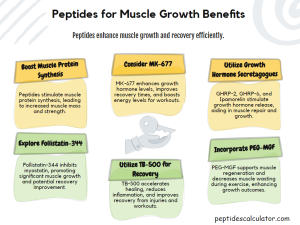
Growth Hormone Secretagogues, which include peptides such as GHRP-2, GHRP-6, Ipamorelin, and CJC-1295 DAC alongside ModGRF 1-29, are key players in stimulating the release of growth hormone. These compounds are designed to enhance muscle growth and recovery through their ability to promote endogenous hormone secretion. Understanding their mechanisms and applications can provide valuable insights for those seeking to optimize muscle development.
Numerous athletes and fitness enthusiasts have turned to growth hormone secretagogues like GHRP-2, GHRP-6, and Ipamorelin to enhance muscle growth and recovery. These peptides function by stimulating the pituitary gland to release more growth hormone, promoting various physiological benefits.
Increased muscle mass: Enhanced protein synthesis leads to muscle hypertrophy.
Improved recovery: Reduces muscle soreness and speeds up healing.
Fat loss: Assists in decreasing body fat while preserving lean muscle.
Better sleep quality: Promotes restorative sleep, essential for recovery.
Elevated energy levels: Boosts overall stamina and performance during workouts.
The adoption of these peptides is often seen as a strategic approach for those seeking ideal results from their training regimens.
CJC-1295 DAC and ModGRF 1-29 are two powerful growth hormone secretagogues that work synergistically to enhance muscle growth and recovery. CJC-1295 DAC functions as a long-acting analog of growth hormone-releasing hormone (GHRH), stimulating the pituitary gland to release endogenous growth hormone over an extended period. In contrast, ModGRF 1-29, a modified version of GHRH, promotes a rapid release of growth hormone, leading to increased muscular hypertrophy and improved recovery times. Together, these peptides optimize the pulsatile secretion of growth hormone, maximizing anabolic effects. Users often report enhanced energy levels, reduced muscle soreness, and improved workout performance, making CJC-1295 DAC and ModGRF 1-29 a compelling option for those seeking to augment their fitness results.
Muscle-building peptides play an essential role in enhancing muscle growth and recovery. Key examples include MK-677, known for its ability to increase growth hormone levels, Follistatin-344, which promotes muscle development, and PEG-MGF, a peptide that aids in muscle repair. Understanding the benefits and applications of these peptides can greatly impact a training regimen.
MK-677, also known as Ibutamoren, stands out in the domain of muscle-building peptides for its ability to mimic the action of ghrelin, the hunger hormone. This characteristic allows it to stimulate growth hormone secretion, which can enhance muscle growth and recovery. Users often report increased appetite and improved sleep quality, further supporting muscle development.
Key benefits of MK-677 include:
Enhanced muscle mass and strength
Improved recovery times post-exercise
Increased bone density
Boosted metabolism and fat loss
Elevated energy levels and overall well-being
As a result, MK-677 is frequently considered by athletes and fitness enthusiasts aiming to optimize their training outcomes and physical performance.
Follistatin-344 has garnered attention as a potent peptide for promoting muscle growth due to its unique ability to inhibit myostatin, a protein that restricts muscle development. By blocking myostatin, Follistatin-344 creates an environment conducive to muscle hypertrophy, allowing for enhanced gains in strength and size. Research indicates that this peptide may also improve recovery times following intense workouts, supporting overall athletic performance. It is often favored by bodybuilders and athletes looking to maximize their training results. While promising, users should approach Follistatin-344 with caution, as individual responses can vary. Understanding proper dosing and potential side effects is vital for those considering its use in their muscle-building regimen.
Building upon the exploration of peptides that enhance muscle growth, PEG-MGF (Pegylated Mechano Growth Factor) emerges as a significant player in this arena. This peptide is derived from the insulin-like growth factor and plays an essential role in muscle repair and development. Its unique pegylation allows for extended half-life, increasing its effectiveness in promoting muscle hypertrophy and recovery.
Stimulates muscle satellite cell activation
Enhances muscle fiber regeneration
Supports muscle growth post-exercise
Improves recovery time after intense workouts
May reduce muscle wasting during caloric deficits
The incorporation of PEG-MGF into a workout regimen may offer substantial benefits for individuals seeking to optimize their muscle-building efforts and recovery processes.
Peptides such as TB-500 and BPC-157 have garnered attention for their potential in enhancing workout recovery and promoting injury healing. TB-500 is known for its ability to aid in tissue repair and reduce inflammation, while BPC-157 is recognized for its regenerative properties. Together, these peptides may provide valuable support for athletes seeking to recover more effectively from intense training and injuries.
In the domain of workout recovery and injury healing, TB-500 stands out as a powerful peptide known for its regenerative properties. This peptide is derived from thymosin beta-4 and is recognized for its ability to enhance healing processes and promote muscle repair. Athletes and fitness enthusiasts often turn to TB-500 to facilitate quicker recovery from injuries and reduce inflammation.
Key benefits of TB-500 include:
Accelerated healing of muscles and tendons
Improved flexibility and range of motion
Reduced inflammation and pain
Enhanced endurance during workouts
Support for overall muscle growth and recovery
As a result, TB-500 remains a popular choice for those seeking to optimize their workout recovery and maintain peak performance.
BPC-157, known as Body Protective Compound-157, has garnered attention in the fitness community for its remarkable capabilities in promoting recovery and healing from injuries. This peptide is derived from a protein found in gastric juice and is believed to enhance the healing process by increasing blood flow and collagen production. Users report accelerated recovery from tendon, ligament, and muscle injuries, making it particularly valuable for athletes and fitness enthusiasts. BPC-157 may also reduce inflammation and promote the regeneration of various tissues, contributing to improved overall performance. Although research is ongoing, its potential benefits for workout recovery and injury healing position BPC-157 as a promising supplement in the domain of athletic recovery strategies.
In the domain of peptides for muscle growth, several common questions arise regarding their use and safety. Individuals often inquire about the necessity of cycling muscle peptides, their applicability for bulking versus cutting, and the safety comparison between MK-677 and GHRPs. Addressing these FAQs can provide valuable insights for those considering peptide supplementation.
How essential is it to cycle muscle peptides for optimal results? Cycling muscle peptides can enhance their effectiveness and help mitigate tolerance, which may develop with prolonged use. Users often consider cycling to maintain peak benefits while minimizing potential side effects.
Key points regarding the cycling of muscle peptides include:
Maximized efficacy: Cycling can help sustain the desired muscle growth effects.
Tolerance management: Periodic breaks may prevent the development of tolerance.
Recovery optimization: Cycling allows the body to reset, promoting natural recovery processes.
Monitoring side effects: Users can better assess any adverse reactions during breaks.
Personalized protocols: Individual responses may dictate unique cycling strategies for each user.
Understanding these aspects can lead to more informed decisions regarding peptide use.
While many fitness enthusiasts wonder about the versatility of peptides, they can indeed be utilized effectively for both bulking and cutting phases. During bulking, peptides like MK-677 promote muscle growth and enhance recovery, allowing for increased calorie consumption and muscle gain. Conversely, during cutting, peptides such as CJC-1295 can aid in fat loss while preserving lean muscle mass.
Incorporating these peptides into a structured diet and training program can optimize results, making them a valuable tool for body composition goals. Understanding how to use them properly is key to achieving desired outcomes.
When comparing the safety profiles of MK-677 and Growth Hormone-Releasing Peptides (GHRPs), it is essential to evaluate their mechanisms of action and potential side effects. MK-677, a selective agonist of the ghrelin receptor, tends to have a more stable profile with fewer acute side effects. In contrast, GHRPs, which stimulate growth hormone release, may lead to fluctuations in hormone levels and associated side effects.
MK-677 is generally well-tolerated with minimal side effects.
GHRPs can cause increased hunger and potential insulin sensitivity issues.
MK-677 has a longer half-life, promoting steady hormone levels.
GHRPs may require more frequent dosing.
Individual responses to each peptide can vary considerably.
Understanding these differences helps users make informed choices.
THIS PRODUCT IS INTENDED AS A RESEARCH CHEMICAL ONLY. This designation allows the use of research chemicals strictly for in vitro testing and laboratory experimentation only. All product information available on this website is for educational purposes only. Bodily introduction of any kind into humans or animals is strictly forbidden by law. This product should only be handled by licensed, qualified professionals. This product is not a drug, food, or cosmetic and may not be misbranded, misused or mislabled as a drug, food or cosmetic.