Cardiogen
Cardiogen is a bioregulatory peptide that influences fibroblast behavior in the heart and other tissues. By moderating cell proliferation and apoptosis it may reduce scarring, improve cardiac remodeling, and enhance the effectiveness of conventional therapies following cardiac injury.
PEPTIDES LIST
- Adipotide (FTPP)
- AICAR
- AOD9604
- ARA-290
- B7-33
- BPC-157
- Bronchogen
- Cagrisema
- Cagrilintides
- Cardiogen
- Cartalax
- Cerebrolysin (215mg/ml, 10ml)
- Chonluten
- CJC-1295 DAC
- Cortagen
- DSIP
- Epithalon (Epitalon)
- Follistatin-315
- Follistatin-344
- FOXO4-DRI
- GHK-Cu (Copper Peptide)
- GHK Basic
- GHRP-2
- GHRP-6
- GHRH (GH-Releasing Hormone)
- Glutathione
- Gonadorelin (GnRH)
- GLP2 & GLP3
- hGH Fragment 176-191
- Hexarelin
- Humanin
- Ipamorelin
- Kisspeptin-10
- KPV (ACTH (11-13) alpha-MSH)
- Liraglutide (GLP-1 Analogue)
- Livagen
- LL-37 (CAP-18)
- Melanotan 2 (Melanotan II)
- Mezdutide
- MGF (C-terminal)
- ModGRF 1-29 (CJC-1295 No DAC)
- MK-677 (Ibutamoren)
- MOTS-c
- N-Acetyl Epithalon Amidate
- N-Acetyl Selank Amidate
- N-Acetyl Semax Amidate
- NAD+
- Ovagen
- Oxytocin+
- Pancragen
- PE-22-28
- PEG-MGF (Pegylated MGF)
- Pinealon
- PNC-27
- Prostamax
- PT-141 (Bremelanotide)
- P21 (P021)
- Retatrutide
- Snap8
- Tesa_Ipa_Blend
- Triblend
- Selank
- Semaglutide (GLP-1 Analogue)
- Semax
- Sermorelin
- SS-31
- Survodutide
- TB-500
- Tesamorelin
- Testagen
- Thymagen
- Thyrotropin-TRH
- Tirzepatide
- Triptorelin
- Vesugenas
- Vesilute
- Vilon
- VIP (Vasoactive Intestinal Peptide)
- GLP2
- GLP3
- Klow
- Klow8
- SLU-PP-332
- BAM-15
- Orforglipron
- Noopept
- 9-Me-BC
- Methylene Blue
- Lemon Bottle

Cardiogen’s primary targets are fibroblasts, the versatile cells responsible for tissue repair, scarring, and extracellular matrix maintenance. By reshaping fibroblast signaling, Cardiogen supports cardiac recovery, aids vascular health, and may offer synergy when combined with standard-of-care regimens for heart failure and hypertension.
Cardiogen is described as a peptide and bio-regulator that supports cell function—particularly fibroblasts, which are essential for healing and scar formation. It’s primarily discussed in research contexts related to heart health, with additional notes on tissue healing and signaling effects in other systems.
| Protocol Item | Guidance |
|---|---|
| Dose | 1–5 mg per dose |
| Cycling Style | Bio-regulators are typically cycled as periodic doses rather than continuous daily consumption. |
| Phase | Schedule |
|---|---|
| Loading Phase (Year 1) | Month 1: DailyMonths 2–3: Daily for 10–20 days at the start of each monthMonths 4–12: Off |
| Maintenance Phase (Year 2+) | 3× per year, spread out evenly |
Caution & Contraindications:
Caution: Use caution in individuals with existing heart conditions or arrhythmias, as it may affect heart rate.
Contraindications: Individuals with severe heart failure.
Reconstitution Options (Vial Format):
• 20 mg
Reconstitution (General Handling):
• Use sterile technique and sanitize the vial stopper before access.
• Add bacteriostatic water slowly along the vial wall to minimize foaming.
• Gently swirl/roll until fully dissolved (avoid vigorous shaking).
• Choose a diluent volume that makes a 1–5 mg dose easy to measure accurately.
• Store according to the product label/spec sheet and protect from light as applicable.
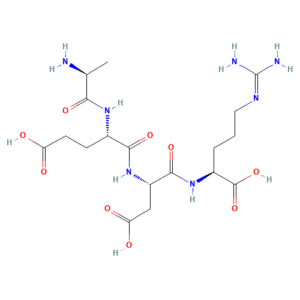
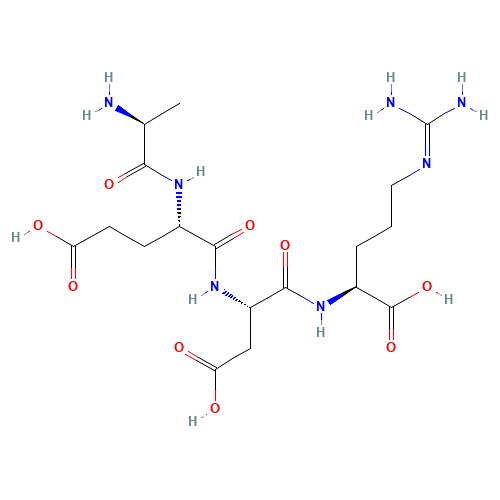
Molecular Formula: C18H31N7O9
Molecular Weight: 489.5 g/mol
PubChem CID: 11583989
Alternative Names: SCHEMBL3194515
In cardiac tissue, Cardiogen appears to promote cardiomyocyte proliferation while tempering fibroblast overactivity. This balance can limit scar formation, improve long-term cardiac remodeling, and reduce apoptosis via p53 down-regulation—key factors in chronic heart failure outcomes.
Interestingly, while p53 suppression aids cardiomyocyte survival, preclinical models of M-1 sarcoma suggest Cardiogen can trigger the opposite effect in tumors—enhancing apoptosis and disrupting aberrant vasculature. Dose-dependent responses highlight its potential role as an adjunctive cancer therapy.
Prostate fibroblasts help orchestrate tumor microenvironments. Studies show Cardiogen can normalize age-related shifts in paracrine signaling, potentially lowering the risk of tumor initiation or slowing progression by restoring a healthier stromal milieu.
Though comparatively early in its research journey, Cardiogen showcases wide-ranging bioregulatory potential—from cardiovascular support to oncologic applications. Its favorable bioavailability in mice and low reported side-effect profile make it a compelling candidate for further study in heart failure, hypertension, and oncology adjuncts.
As with many research peptides, animal dose data do not directly scale to humans. Cardiogen is available strictly for educational and scientific purposes and should be handled by licensed researchers.
Article Author :
The above literature was researched, edited and organized by Dr. Logan, M.D. Dr. Logan holds a doctorate degree from https://case.edu/medicine/Case Western Reserve University School of Medicine and a B.S. in molecular biology.
Case Western Reserve University School of Medicine
ALL ARTICLES AND PRODUCT INFORMATION PROVIDED ON THIS WEBSITE ARE FOR INFORMATIONAL AND EDUCATIONAL PURPOSES ONLY.
The product information featured on this website pertains exclusively to in-vitro studies. In-vitro studies, also known as ‘in glass’ studies, are conducted outside of living organisms. It’s important to emphasize that these products do not constitute medicines or drugs and have not received FDA approval for the prevention, treatment, or cure of any medical conditions, ailments, or diseases. It is crucial to note that the introduction of these products into the bodies of humans or animals is strictly prohibited by law.
THIS PRODUCT IS INTENDED AS A RESEARCH CHEMICAL ONLY. This designation allows the use of research chemicals strictly for in vitro testing and laboratory experimentation only. All product information available on this website is for educational purposes only. Bodily introduction of any kind into humans or animals is strictly forbidden by law. This product should only be handled by licensed, qualified professionals. This product is not a drug, food, or cosmetic and may not be misbranded, misused or mislabled as a drug, food or cosmetic.