
B7-33
B7-33 is a peptide currently undergoing active research, primarily due to its potent anti-fibrotic properties. Researchers are investigating its potential to reduce fibrosis in conditions ranging from heart failure and lung inflammation to kidney disorders and more. Animal studies have shown that B7-33 can significantly diminish fibrosis by approximately 50%, leading to improved survival rates following injuries. This peptide offers a novel approach to treating heart failure, a field that has seen limited advancements in the past two decades. Additionally, B7-33 has demonstrated promise in mitigating excessive scar formation after cardiac injuries and shows potential for addressing various vascular disorders and even preeclampsia during pregnancy, making it a versatile candidate for combating fibrosis-related diseases.
PEPTIDES LIST
- Adipotide (FTPP)
- AICAR
- AOD9604
- ARA-290
- B7-33
- BPC-157
- Bronchogen
- Cagrisema
- Cagrilintides
- Cardiogen
- Cartalax
- Cerebrolysin (215mg/ml, 10ml)
- Chonluten
- CJC-1295 DAC
- Cortagen
- DSIP
- Epithalon (Epitalon)
- Follistatin-315
- Follistatin-344
- FOXO4-DRI
- GHK-Cu (Copper Peptide)
- GHK Basic
- GHRP-2
- GHRP-6
- GHRH (GH-Releasing Hormone)
- Glutathione
- Gonadorelin (GnRH)
- GLP2 & GLP3
- hGH Fragment 176-191
- Hexarelin
- Humanin
- Ipamorelin
- Kisspeptin-10
- KPV (ACTH (11-13) alpha-MSH)
- Liraglutide (GLP-1 Analogue)
- Livagen
- LL-37 (CAP-18)
- Melanotan 2 (Melanotan II)
- Mezdutide
- MGF (C-terminal)
- ModGRF 1-29 (CJC-1295 No DAC)
- MK-677 (Ibutamoren)
- MOTS-c
- N-Acetyl Epithalon Amidate
- N-Acetyl Selank Amidate
- N-Acetyl Semax Amidate
- NAD+
- Ovagen
- Oxytocin+
- Pancragen
- PE-22-28
- PEG-MGF (Pegylated MGF)
- Pinealon
- PNC-27
- Prostamax
- PT-141 (Bremelanotide)
- P21 (P021)
- Retatrutide
- Snap8
- Tesa_Ipa_Blend
- Triblend
- Selank
- Semaglutide (GLP-1 Analogue)
- Semax
- Sermorelin
- SS-31
- Survodutide
- TB-500
- Tesamorelin
- Testagen
- Thymagen
- Thyrotropin-TRH
- Tirzepatide
- Triptorelin
- Vesugenas
- Vesilute
- Vilon
- VIP (Vasoactive Intestinal Peptide)
- GLP2
- GLP3
- Klow
- Klow8
- SLU-PP-332
- BAM-15
- Orforglipron
- Noopept
- 9-Me-BC
- Methylene Blue
- Lemon Bottle

B7-33 is a synthetic peptide, derived from the human H2-relaxin protein, renowned for its potent anti-fibrotic capabilities. Unlike some relaxin-related peptides, B7-33 does not increase cAMP production. Instead, it functions by promoting ERK1/2 phosphorylation, facilitating the expression of matrix metalloproteinase 2 (MMP2), and aiding in the degradation of extracellular collagen.
The relaxin family encompasses four proteins: relaxin, insulin-like peptide 3, H3-relaxin, and insulin-like peptide 5. These proteins, closely related to insulin, exert diverse effects on various bodily systems, including musculoskeletal, cardiovascular, and reproductive functions.
These relaxin peptides interact with four endogenous receptors grouped into two pairs: RXFP1/2 and RXFP3/4, each with distinct functions. RXFP-1, for instance, plays key roles in sperm motility, pregnancy, vascular health, and joint function. These receptors can be stimulated not only by relaxin proteins but also by various other substances, including cAMP, orexin, corticotropin-releasing factor (CRF), insulin-like peptides, and GLP-1. Many of these agonists possess anti-inflammatory, antioxidant, and wound-healing properties. This extensive array of functions has prompted rigorous research into relaxin and its derivatives for treating conditions like acute heart failure and fibrotic disorders.
B7-33 is part of a family of relaxin proteins discussed for helping reduce inflammation and support healing across various bodily functions, including the muscles, heart, and lungs.
B7-33 is derived from the hormone H2-relaxin. It’s described as retaining beneficial anti-scarring effects while avoiding increased cAMP levels that may be linked to unwanted side effects (e.g., tumor growth).
Deeper Research Notes (Mechanism Summary):
• B7-33 binds to the receptor RXFP1, activating a signaling pathway known as pERK, which is discussed for reducing scarring (fibrosis) and supporting healthier tissue growth.
• By promoting pERK activation, B7-33 is described as helping break down excessive scar tissue (fibrosis) in organs such as the heart or lungs.
• Compared to the original H2-relaxin protein, B7-33 is described as easier to produce due to its simpler structure.
• Beyond fibrotic support, B7-33 is discussed for potentially preventing fibrosis around implanted medical devices, helping them function better and last longer.
| Protocol Item | Guidance |
|---|---|
| Dose | 200–800 mcg per dose |
| Cycling | Daily, for 30-day cycles (or shorter), with a 30-day minimum cycle break between |
Caution & Contraindications:
Caution:
• Individuals with hormonal imbalances or related medical conditions
• May cause nausea and/or diarrhea
Contraindications:
• Individuals with known hypersensitivity to relaxin family peptides
Reconstitution Options (Vial Format):
• 6 mg
Reconstitution (General Handling):
• Use sterile technique and follow the product’s label/spec sheet for diluent type and volume.
• Add diluent slowly and gently swirl/roll until fully dissolved (avoid vigorous shaking).
• Store per label guidance and protect from light as applicable.
Sequence: VIKLSGRELVRAQIAISGMSTWSKRSL
Molecular Formula: C318H164N84O40
Molecular Weight: (B7-33)H2, GTPL9321
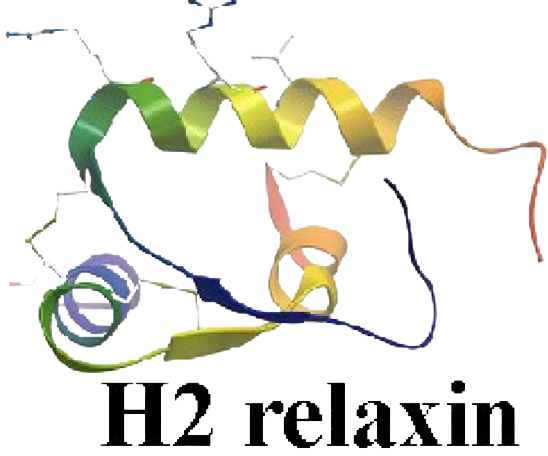
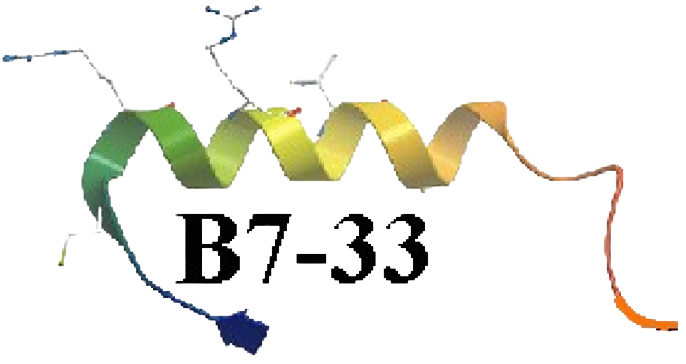
One of the advantages of B7-33 over the native H2-relaxin protein is that it does not activate the cAMP pathway but still retains the ability to promote the full anti-fibrotic effects of the parent peptide. This is not, however, the only advantage that B7-33 offers. Just as important among its attributes is the fact that B7-33 is easier to produce. Because B7-33 has less complicated 2D and 3D structures, it is much less laborious to produce a functional B7-33 protein than a full H2-relaxin protein. This ease of production leads to less expensive production as well.
B7-33 Function
B7-33 has a distinct advantage due to its unique structure. Although it exhibits a higher affinity for binding to the RXFP1 receptor compared to the native H2-relaxin protein, B7-33 has a preference for activating the pERK pathway over the cAMP pathway. The pERK pathway is known for its involvement in cell cycle regulation, particularly in arresting cells in the G1 phase. This pathway is relevant to various diseases, including protein-misfolding disorders like Alzheimer's and Creutzfeld-Jacob disease.
Anti-Fibrotic Properties
Fibrosis, characterized by the formation of scar tissue or disorganized tissue regeneration, is the end result of many chronic diseases, contributing to organ failure in conditions such as cardiovascular disease, lung disease, and liver cirrhosis. In 2012, H2-relaxin underwent phase II clinical trials as a treatment for acute heart failure, demonstrating immediate vasodilatory effects and reduced long-term scarring post-heart damage. This marked a significant advancement as the first new acute heart failure treatment in two decades.
However, while H2-relaxin offers substantial benefits, it has limitations as a therapeutic agent. Production is challenging, and it can only be administered through intravenous injection. Moreover, the full protein has been linked to increased heart rate and cancer progression, particularly in prostate cancer. These effects are largely attributed to its activation of the cAMP pathway, prompting efforts to reduce cAMP activation, resulting in the development of B7-33.
Dr. Akhter Hossain, one of the primary developers of B7-33, notes that the peptide increases MMP-2 production similarly or even slightly more than H2-relaxin. This translates into a significant reduction in cardiac fibrosis in rat models of heart failure induced by myocardial infarction (MI). With reduced fibrosis comes an improvement in heart function, reducing long-term symptoms and complications of heart failure. Findings suggest that B7-33 may reduce overall heart scarring following injury by approximately 50%. Similar effects were observed in mouse models of asthma and lung fibrosis.
To further assess the advantages of B7-33 over H2-relaxin, Dr. Hossain and colleagues investigated the impact of B7-33 on mice with prostate cancer. Remarkably, B7-33 not only failed to promote tumor growth when administered at doses required for fibrosis treatment but also showed no tumor-promoting effects even at higher doses. This is attributed to B7-33’s predominant action through the pERK pathway, without stimulating cAMP production.
Blood Vessel Protection
Preeclampsia is a common complication of pregnancy that leads to high blood pressure and reduced fetal weight. While manageable to a large degree, preeclampsia can be difficult to control and, in some cases, life-threatening to both mother and fetus. In the most extreme cases of preeclampsia, immediate delivery of the baby is necessary, making it a common causes of pre-term delivery. Research, however, suggests that relaxin and thus B7-33 may prove useful in controlling preeclampsia even in severe cases.
The most recent research available suggests that B7-33 likely acts at the RXFP-1 receptor to increase the production of VEGF in cytotrophoblasts. These cells, found in the developing fetus, are critical in helping to establish blood flow between the maternal circulation and the developing fetus. By stimulating VEGF production, B7-33 promotes the growth of blood vessels and thus improves blood supply between mother and child[10].
This same research also reveals that lipidated B7-33 has a much longer in vivo half-life and that lipidation has no impact on the peptides activity[10]. A longer half-life would make B7-33 an even more effective therapeutic and increases the odds that enteral administration can result in therapeutic plasma levels of the protein.
B7-33 in Anti-Fibrotic Materials
B7-33 presents an ideal coating option for use in medical implants. In a study, the release of B7-33 from the coating of a device reduced fibrotic capsule thickness by nearly 50% over a 6-week trial. These findings represent a significant step forward and open up possibilities for improving a wide range of implantable medical devices. Moreover, the use of B7-33 and similar peptides may eliminate the need for systemic drugs (such as Plavix or aspirin for cardiac stents) to reduce fibrosis of implanted medical devices. This would enhance device safety and expand their applicability to a broader range of patients, including those with more severe medical conditions.
B7-33 is a novel peptide with potent anti-fibrotic effects. It is under active research and investigation as a means of reducing fibrosis in acute and chronic diseases like heart failure, lung inflammation, and more. In animal studies, B7-33 has reduced fibrosis by roughly 50%, leading to prolonged survival following injury and offering the first new means of treating heart failure in 20 years. There is additional interest in using B7-33 to reduce the foreign body response to implanted medical devices. Once again, B7-33 reduces fibrotic capsule formation in implanted devices by approximately 50%, paving the way to new and improved implantable medical devices while also extending the utility and application of existing devices. B7-33 is not just an anti-fibrotic peptide though. It has other properties, with its ability to reduce blood pressure and protect vasculature being of greatest interest. Studies in animal models of preeclampsia suggest that B7-33 might be a useful tool in treating this difficult-to-manage disease, potentially allowing more women to carry children to term in a manner that is safe for both mother and baby.
Article Author :
The above literature was researched, edited and organized by Dr. Logan, M.D. Dr. Logan holds a doctorate degree from https://case.edu/medicine/Case Western Reserve University School of Medicine and a B.S. in molecular biology.
Case Western Reserve University School of Medicine
ALL ARTICLES AND PRODUCT INFORMATION PROVIDED ON THIS WEBSITE ARE FOR INFORMATIONAL AND EDUCATIONAL PURPOSES ONLY.
The product information featured on this website pertains exclusively to in-vitro studies. In-vitro studies, also known as ‘in glass’ studies, are conducted outside of living organisms. It's important to emphasize that these products do not constitute medicines or drugs and have not received FDA approval for the prevention, treatment, or cure of any medical conditions, ailments, or diseases. It is crucial to note that the introduction of these products into the bodies of humans or animals is strictly prohibited by law.
THIS PRODUCT IS INTENDED AS A RESEARCH CHEMICAL ONLY. This designation allows the use of research chemicals strictly for in vitro testing and laboratory experimentation only. All product information available on this website is for educational purposes only. Bodily introduction of any kind into humans or animals is strictly forbidden by law. This product should only be handled by licensed, qualified professionals. This product is not a drug, food, or cosmetic and may not be misbranded, misused or mislabled as a drug, food or cosmetic.