Adipotide (FTPP)
Adipotide-FTPP is a synthetic peptide designed to target and reduce fat cells by inducing apoptosis in adipocytes. It has potential applications in weight loss and fat reduction, though further research is needed for clinical approval.
PEPTIDES LIST
- Adipotide (FTPP)
- AICAR
- AOD9604
- ARA-290
- B7-33
- BPC-157
- Bronchogen
- Cagrisema
- Cagrilintides
- Cardiogen
- Cartalax
- Cerebrolysin (215mg/ml, 10ml)
- Chonluten
- CJC-1295 DAC
- Cortagen
- DSIP
- Epithalon (Epitalon)
- Follistatin-315
- Follistatin-344
- FOXO4-DRI
- GHK-Cu (Copper Peptide)
- GHK Basic
- GHRP-2
- GHRP-6
- GHRH (GH-Releasing Hormone)
- Glutathione
- Gonadorelin (GnRH)
- GLP2 & GLP3
- hGH Fragment 176-191
- Hexarelin
- Humanin
- Ipamorelin
- Kisspeptin-10
- KPV (ACTH (11-13) alpha-MSH)
- Liraglutide (GLP-1 Analogue)
- Livagen
- LL-37 (CAP-18)
- Melanotan 2 (Melanotan II)
- Mezdutide
- MGF (C-terminal)
- ModGRF 1-29 (CJC-1295 No DAC)
- MK-677 (Ibutamoren)
- MOTS-c
- N-Acetyl Epithalon Amidate
- N-Acetyl Selank Amidate
- N-Acetyl Semax Amidate
- NAD+
- Ovagen
- Oxytocin+
- Pancragen
- PE-22-28
- PEG-MGF (Pegylated MGF)
- Pinealon
- PNC-27
- Prostamax
- PT-141 (Bremelanotide)
- P21 (P021)
- Retatrutide
- Snap8
- Tesa_Ipa_Blend
- Triblend
- Selank
- Semaglutide (GLP-1 Analogue)
- Semax
- Sermorelin
- SS-31
- Survodutide
- TB-500
- Tesamorelin
- Testagen
- Thymagen
- Thyrotropin-TRH
- Tirzepatide
- Triptorelin
- Vesugenas
- Vesilute
- Vilon
- VIP (Vasoactive Intestinal Peptide)
- GLP2
- GLP3
- Klow
- Klow8
- SLU-PP-332
- BAM-15
- Orforglipron
- Noopept
- 9-Me-BC
- Methylene Blue
- Lemon Bottle

Adipotide, also known as FTPP or the proapoptotic peptide, is a promising new drug for weight loss and diabetes. It works by targeting and destroying fat cells, leaving the rest of the body unharmed. Studies on primates have shown that adipotide can cause significant weight loss, improve insulin sensitivity, and reduce some of the adverse effects of type 2 diabetes.
Adipotide is a research peptide designed to target fat tissue by acting on blood vessels that supply adipose tissue. The dosing guidance below reflects a weight-based protocol commonly expressed as mcg per lb per dose.
Dosing (Weight-Based):
Reference formula: 4.53 mcg per lb (per dose).
Frequency: Commonly listed as once daily.
| Body Weight (lbs) | Daily Dose (mcg) | Basis |
|---|---|---|
| 100–150 | 455–680 mcg | 4.53 mcg/lb |
| 151–200 | 685–905 mcg | 4.53 mcg/lb |
| 201–250 | 910–1150 mcg | 4.53 mcg/lb |
Cycling:
• Daily for 30-day cycles (or shorter).
• Use a minimum 30-day break between cycles.
Cautions & Contraindications:
Cautions: May cause fluid retention, nausea, diarrhea, and/or stomach discomfort.
Contraindications:
• Pregnant individuals
• Individuals with a history of, or current liver, kidney, or pancreas disease
Reconstitution Options:
• 2 mg vial format
• 10 mg vial format
Reconstitution (General Handling):
• Use sterile technique and clean the stopper with an alcohol swab.
• Add bacteriostatic water slowly along the vial wall to minimize foaming.
• Gently swirl/roll until fully dissolved (do not shake).
• Choose a diluent volume that gives a concentration you can measure accurately for your target mcg dose.
• Store refrigerated (2–8 °C), protected from light.
Sequence: Cysteine-Lysine-Glycine-Glycine-Arginine-Alanine-Lysine-Aspartate-Cysteine-Glycine-Glycine-(Lysine-Leucine-Alanine-Lysine-Leucine-Alanine-Lysine)2
Molecular Formula: C152H252N44O42
Molecular Weight: 2611.41 grams per mole
IMPORTANT: THIS PRODUCT IS INTENDED AS A RESEARCH CHEMICAL ONLY. This designation allows the use of research chemicals strictly for in vitro testing and laboratory experimentation only. All product information available on this website is for educational purposes only. Bodily introduction of any kind into humans or animals is strictly forbidden by law.
Adipotide, a groundbreaking new drug, entered phase I clinical trials in 2011 to test its ability to stop fat cells. Studies on rhesus monkeys showed that adipotide kills the blood vessels that feed white fat cells, causing them to die. This led to significant weight loss, a rapid reduction in body mass index (BMI), and improved insulin resistance.
Interestingly, Adipotide treatment not only caused weight loss, but it also changed monkeys' eating habits. The monkeys that lost weight on Adipotide ate less food. This suggests that Adipotide may affect people's food choices in a complex way.
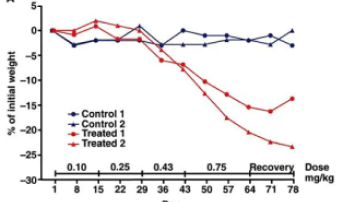
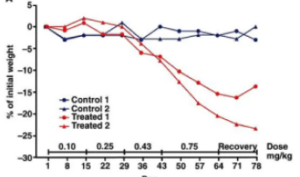
The red data points show two different doses of adipotide. The graph highlights the significant impact of adipotide treatment on weight loss, showing a compelling difference in outcomes.
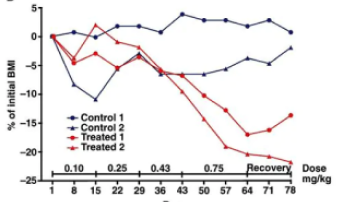
Graph B shows the effect of adipotide treatment on BMI compared to the control group. The blue line represents the BMI of the control group, and the red line represents the BMI of people who received adipotide treatment. The sharp drop in BMI in the treatment group demonstrates that adipotide effectively reduces BMI. This supports the idea that adipotide could be a valuable tool for managing weight and related health problems.
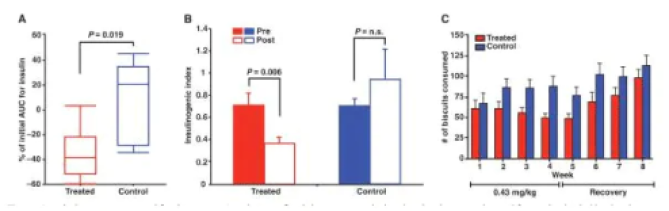
Chart A shows the change in insulin requirements for the treated group (red) and the control group (blue), as measured by the area under the curve (AUC). The AUC was calculated from the results of an IVGTT test. There is a noticeable contrast in insulin requirements between the two groups, with the red curve showing the impact of treatment. This graph highlights the significance of the therapy in changing insulin needs.
Overview:
Adipotide is a peptide designed to target and reduce fat tissue by inducing apoptosis in the blood vessels that supply fat cells. Adipotide binds to the prohibitin protein causing a disruption in the supply of blood cells to fat tissue and may offer potential therapeutic use in certain cancers.
Dosing & Cycling:
Cycle daily for 30 days and then take a minimum of 30 days off. 4.53mcg/lb per dose
| Weight (lbs) | Dosing (mcg) |
|---|---|
| Weight 100-150 lbs | 455-680 mcg |
| Weight 151-200 lbs | 685-905 mcg |
| Weight 201-250 lbs | 910-1150 mcg |
THIS PRODUCT IS INTENDED AS A RESEARCH CHEMICAL ONLY. This designation allows the use of research chemicals strictly for in vitro testing and laboratory experimentation only. All product information available on this website is for educational purposes only. Bodily introduction of any kind into humans or animals is strictly forbidden by law. This product should only be handled by licensed, qualified professionals. This product is not a drug, food, or cosmetic and may not be misbranded, misused or mislabled as a drug, food or cosmetic.